
Air, Out Loud
#kairair#building-in-public#weather-network#esp8266#mvp#origin
David Olsson
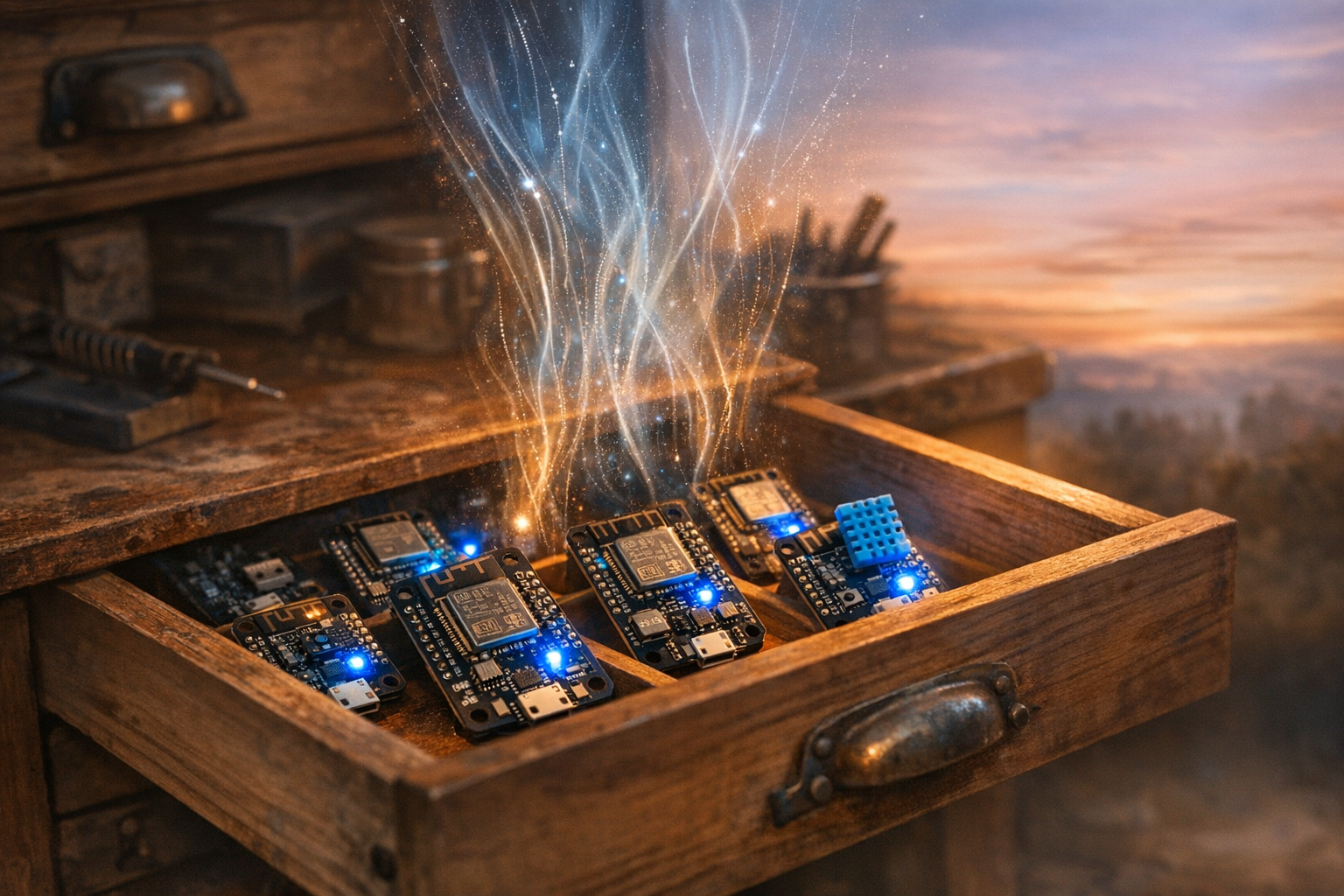
There's a drawer in my office full of little boards.
LoLin NodeMCUs, mostly. ESP8266s the size of a stick of gum, each one wired to a sensor — a BME680 sniffing gas and humidity, a BMP180 reading pressure, a DHT11 doing its honest best with temperature. Every one of them worked. Every one of them, at some point, sat on my desk blinking a tiny OLED with a number on it.
And every one of them told no one.
That's the thing about a sensor on a bench. It measures the air with real precision, prints the reading to a serial monitor, and then the reading dies there. Nobody sees it. Nothing remembers it. You unplug the board, the number is gone, and the air it measured has already moved on.
I had a dozen of these. A dozen little instruments, each fluent in the language of the atmosphere, none of them saying anything out loud.
KAIRair is what happened when I decided that was the actual problem.
from gadgets to a network
The scripts came first. They always do.
Each board had its own sketch — a .ino file with the pins hard-coded, the Wi-Fi credentials pasted in, the sensor logic written from scratch because the last one's code didn't quite fit this one's wiring. Four boards, four sketches, four slightly different versions of the same idea. It was a collection of gadgets. A gadget is a thing that works for you, once, on your desk.
A network is different.
A network is what you get when the measurement doesn't die on the bench — when the board stops talking to a serial monitor and starts talking to one backend, and the backend puts it on one map, and suddenly the reading from my backyard sits next to a reading from yours, and the two of them together say something neither could say alone.
That's the shift the whole project turns on. Not better sensors. Not fancier boards. The decision to point all of them at the same place and let the air speak in the plural.
The drawer of gadgets became kairair-winnipeg, a rough first server that could at least catch what a station threw at it. That became kairair-ota — the same idea, grown up, with a real backend, a real map at kairair.com, and firmware that can update itself in the field without me driving to anyone's backyard with a USB cable.
But I want to be honest about what it is right now.
what MVP means here
KAIRair is an MVP. I mean that precisely, not as an apology.
A minimum viable product is the smallest version of an idea that actually proves the idea. Not a demo. Not a mockup. The real thing, running, at the smallest honest scale — small enough to build well, large enough to be true.
So here is the smallest honest scale KAIRair could be:
| Dimension | The MVP | Not yet |
|---|---|---|
| Where | Backyards | Rooftops, farms, cities |
| What | Weather — temp, humidity, pressure, air | Everything else air carries |
| How many | A first batch of ten | A fleet |
| Station types | Four | A catalog |
| State | Calibration | Ready for hosts |
Ten stations. Four types. Backyard-scale. In calibration right now, which is the unglamorous work of making sure the number a station reports is the number the air actually is — because a network of confident, wrong readings is worse than no network at all.
That's the whole MVP. A handful of stations, in a handful of backyards, measuring the weather and — this is the part that matters — showing it to people. Out loud. On a shared map. In real time.
If that works — if ten stations in ten backyards can be built, calibrated, owned, and trusted — then the idea is proven, and everything after it is just scale.
why backyards, why weather
You could ask why start so small. Why backyards and not a proper sensor grid on municipal poles.
Because backyards are where the trust is.
A weather station on a city pole is infrastructure — it belongs to an institution, it answers to a budget, and if it goes quiet nobody in particular notices. A weather station in your backyard is yours. You plugged it in. You watched it show up on the map. When it says it's 4 degrees and drizzling, you can look out the window and check. That loop — reading, window, "yeah, that's right" — is how a network earns the right to be believed.
And weather is the way in because everyone already has a relationship with it. Nobody needs to be sold on caring what the air is doing. You already check. You already have opinions about it. Weather is the most-used dataset in human history that most people have never actually owned a piece of.
KAIRair is a bet that they'd like to.
the part I'm not saying yet
There's a longer version of this story, and I'll tell it at the end of the series, not the start.
The short version: weather is our context for the experience of air. It's the familiar frame — the temperature, the pressure, the coming rain. But the air itself carries so much more than weather. Pollen. Smoke. Particulates. Sound. The invisible traffic of a living place. A network built to make weather visible is, underneath, a network built to make air visible — and air is full of life.
I'm not going to oversell that here. The MVP measures the weather in ten backyards. That's the promise I have to keep first.
But the drawer is empty now. The boards aren't on my desk blinking numbers at nobody.
They're outside. They're on the map. And for the first time, the air is saying something out loud.
This is the first post in a series on building KAIRair — the what, the how, the why, and where a backyard weather network goes when it grows up. Next: how four duplicated sketches became one piece of firmware, and why the duplication was the real bug.