
Claimed, and Private by Default
#kairair#privacy#ownership#building-in-public#design#trust
David Olsson
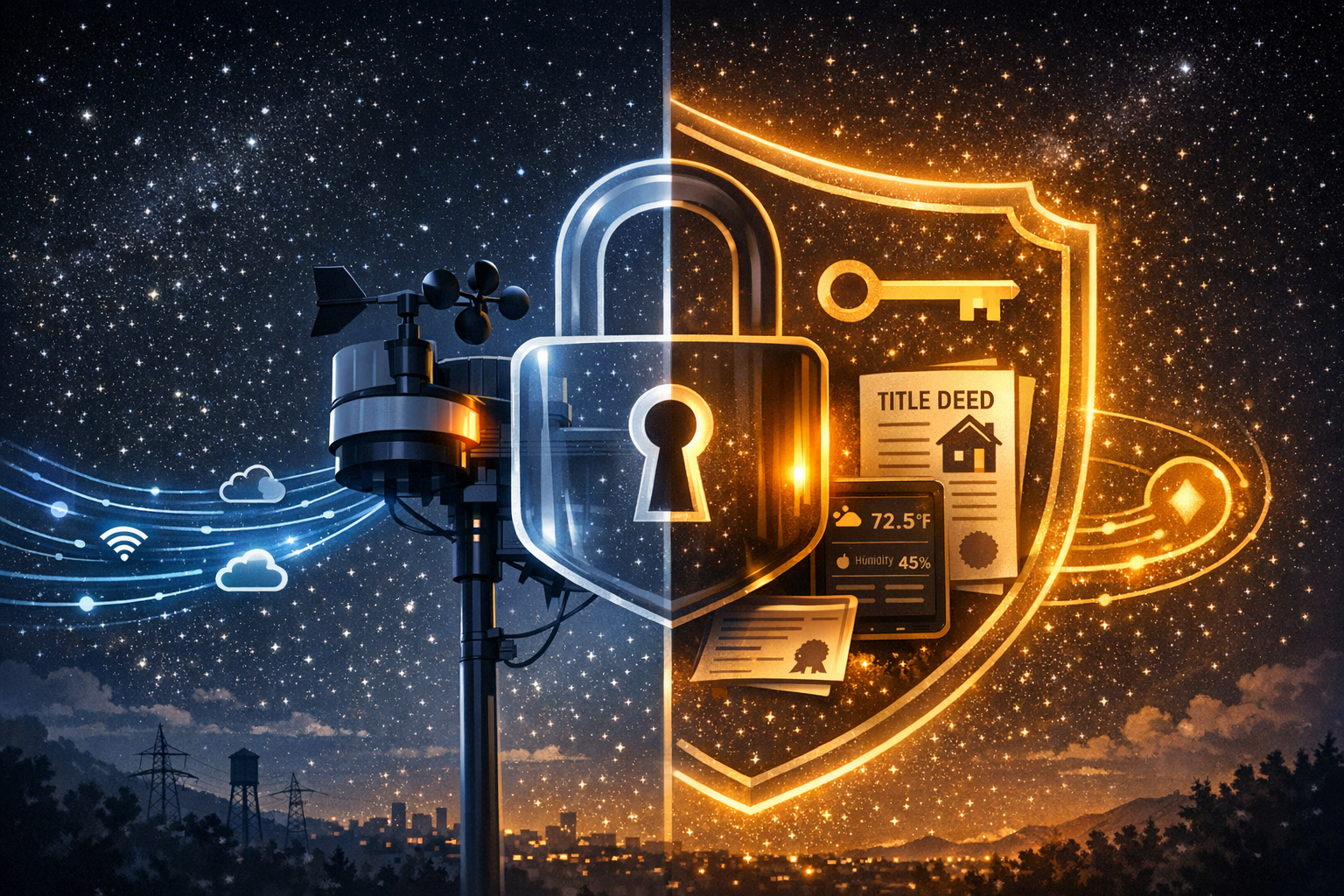
Here is an uncomfortable truth about a backyard weather station: it is a sensor, on the internet, at someone's home.
We spent five posts on how good that is — the network, the source of truth, the dynamic sensors, the safe updates, the power engineering. All of it produces a device that sits outside a person's house and continuously reports what it observes. And the moment you think about it from the resident's side rather than the network's side, a different set of questions shows up.
Whose station is it? Who can see its data? What does its data quietly reveal about the person whose yard it's in?
If a network doesn't have good answers to those, it doesn't deserve to be in anyone's backyard. So this post is about the least flashy and most important design commitment in the whole project: every station is claimed, and it is private by default.
a station belongs to a person
The first decision is ownership, and it's deliberately not neutral.
A station on KAIRair isn't just a device the platform knows about. It belongs to someone — a specific human account that claimed it. That claim is a real step in a device's life. It's built, it's registered, it starts reporting, and at some point a person says "this one is mine," and from then on the station has an owner.
That single fact changes the power relationship. The platform doesn't own the sensor in your yard; you do. The platform operates the network the station reports to — but the station is yours, the claim is yours, and the authority over what that station's presence says about you starts with you, not with us.
This is the opposite of the default in most connected-device land, where the "smart" thing in your home is really the manufacturer's thing, temporarily in your possession, reporting to them. On KAIRair the ownership runs the right direction. A device is claimed by a person, and unclaimed devices are exactly that — not yet anyone's, not yet fully alive.
what a reading quietly says
Now the subtle part, the one that separates a serious approach to privacy from a checkbox.
Weather data feels harmless. It's the temperature. Who cares. But a continuous stream of readings from a fixed location carries more than weather, if you're paying attention. When did the readings start — that's roughly when someone set up their yard. A gap in reporting can hint that nobody's around to notice a station went down. And the location itself, if published precisely, is a pin on the map at somebody's house.
None of that is in the temperature. It's in the metadata around the temperature — the where, the when, the who. And metadata is exactly what people underestimate. You can be scrupulous about the readings and still leak the person, if you're careless about everything attached to them.
So privacy on KAIRair isn't a promise that the data is boring. It's an acknowledgment that the data is more revealing than it looks, and a commitment to defaulting toward protecting the person, not exposing them.
private by default means the default is the safe one
"Private by default" is a phrase people say. It has a precise, testable meaning: the state you're in before you change any settings is the protective one. You should have to opt in to sharing, never have to scramble to opt out of exposure you didn't choose.
That principle shapes the concrete choices. A person's identity isn't attached to their station unless they decide to attach it — a profile is something you choose to make public, with a toggle you control, not a default that quietly links your name to a pin. What the public map and station pages show leans toward the reading and away from the resident. The interesting, shareable thing — "it's 4°C and the pressure is dropping in this neighbourhood" — can be public without the private thing — "and here's exactly whose house that is and who lives there" — coming along for the ride.
The test I hold it to is simple: a host who does nothing but plug in a station and claim it should already be in a safe posture. Sharing more — their name, their face, a precise location, a personal note on their station page — should be a series of deliberate choices they make, each one theirs, each one reversible.
baked in, and more baking all the time
I want to be honest about the tense here, because it matters.
Privacy isn't a feature you finish. It's a direction you keep walking. KAIRair has the foundations — ownership through claiming, opt-in identity, defaults that favour the resident — and it also has a to-do list I'm not going to pretend is empty. There's more to do on location precision, on giving hosts finer control over exactly what their station reveals, on making the privacy choices legible so a person can see what they're sharing at a glance rather than trusting that it's fine.
So the honest formulation is the one I keep using: privacy is baked in, and there's more baking all the time. The foundations are real and they're the right shape. The work of deepening them is ongoing, and I'd rather say that plainly than claim a finished privacy story that no live system honestly has.
What I won't do is treat it as an afterthought — the feature you bolt on once there are enough users to embarrass you. In a network of sensors in people's homes, the person in the home is the whole reason to be careful. Get that wrong and none of the clever engineering matters, because nobody should let you in the backyard in the first place.
Claimed. Private by default. Deepening on purpose. That's the deal, and it's the deal before the network gets big — which is the only time a privacy commitment is worth anything.
Part seven of the KAIRair build series. Previous: Sun, Battery, USB. Next: what a host actually does, and what a host actually gets — from a fully assembled kit or a DIY build all the way to live on the map.