
Five Agents, One Research Run: Inside OAIRA's Deep Research Pipeline
#deep research#agents#AI#OAIRA#intelligence
David Olsson
There's a difference between a research summary and a research synthesis.
A summary aggregates what exists. A synthesis evaluates it, structures it, identifies what's missing, surfaces what's in tension, and produces output that a human analyst could actually use. Summaries are fast. Synthesis requires something closer to expert judgment.
OAIRA's Deep Research pipeline is built for synthesis.
The Five-Agent Architecture
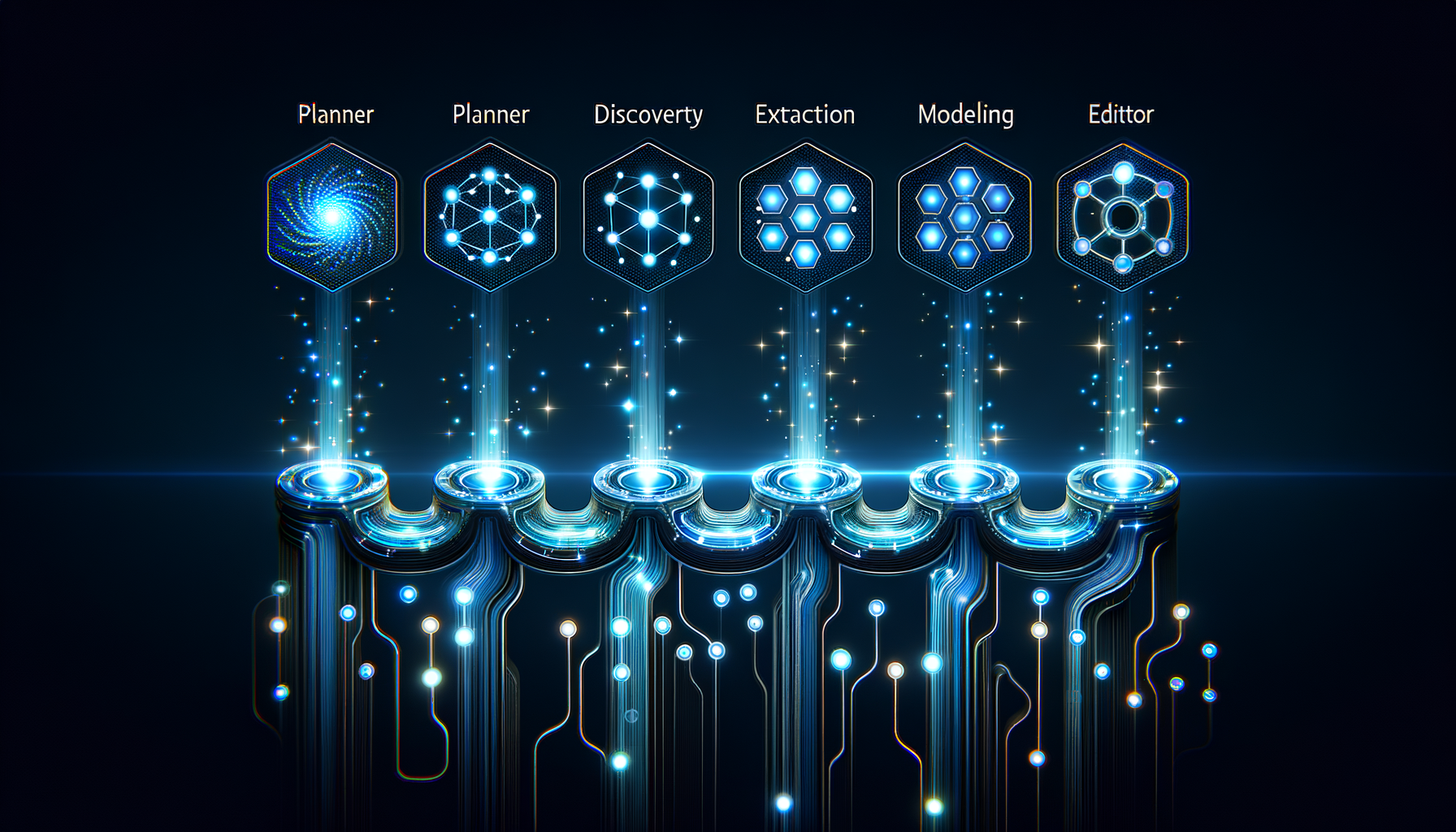
Deep Research in OAIRA runs as a sequential multi-agent pipeline. Each agent has a specific, bounded responsibility. The output of each stage feeds the next.
01. Planner Agent Defines the scope, assumptions, and methodology before any analysis begins. The Planner decides what counts as relevant evidence, what sub-questions the research needs to answer, what sources are available, and how to structure the investigation. This isn't a step you can skip — a research run without a clear scope definition produces outputs that are hard to evaluate and impossible to defend.
02. Discovery Agent Finds relevant evidence from provided resources and domain knowledge. The Discovery agent searches, filters, and retrieves — web research, uploaded documents, survey data, pasted content, and Claude's model knowledge. It operates within the scope defined by the Planner and builds the evidence base for everything that follows.
03. Extraction Agent Extracts claims, metrics, methods, caveats, and quote-ready evidence spans from the discovered material. The Extraction agent turns raw source material into structured, citable research building blocks. This is the step that makes the output auditable — every claim in the final synthesis can be traced to a specific source.
04. Modeling Agent Builds structured claim graphs, themes, contradictions, and uncertainty maps from the extracted evidence. The Modeling agent is where synthesis happens: identifying the pattern across sources, surfacing what sources agree on, flagging what they contradict, and mapping the structure of what is and isn't known.
05. Editor Agent Converts the validated synthesis into publishable, editor-ready structured output. The Editor agent is the interface between the research process and the research artifact — it produces something you can actually share.
The Phase Timeline
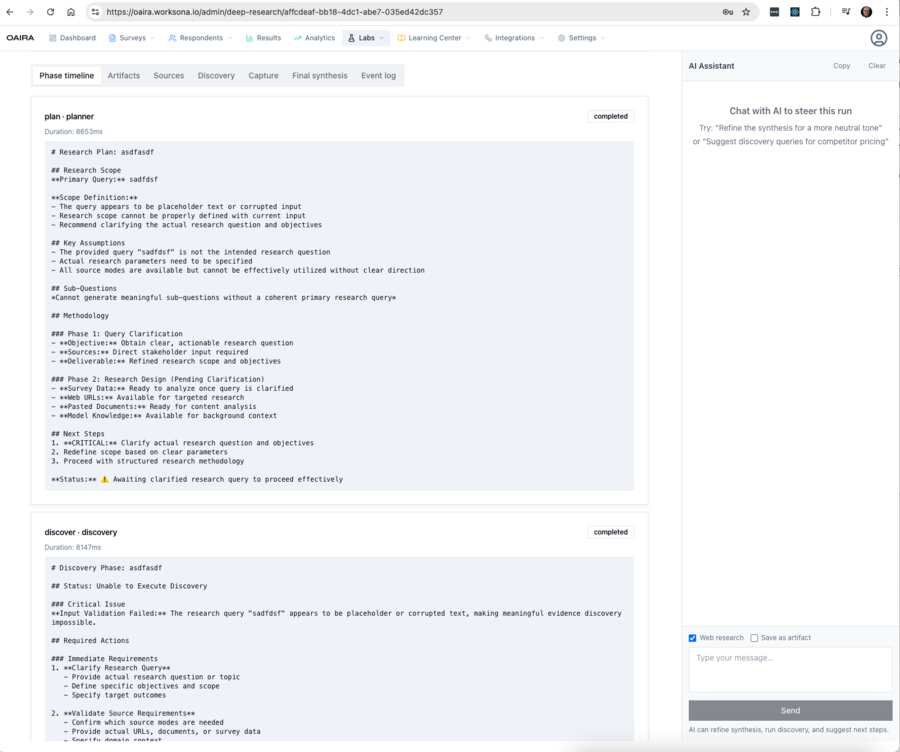
Each agent run is visible in the phase timeline — a real-time view of the pipeline as it executes. You see:
- Which phase is currently running
- How long each phase took
- The full output of each phase, including any warnings or status flags
- Whether the phase completed successfully or encountered issues
This transparency is deliberate. Deep research that disappears into a black box and returns a report isn't trustworthy. Deep research where you can see exactly what each agent found, extracted, and modeled — and where you can identify if an agent made a poor inference — is.
Steering Mid-Run
The pipeline includes an embedded AI assistant on the right panel: "Chat with AI to steer this run."
Suggested interactions include:
- "Refine the synthesis for a more neutral tone"
- "Suggest discovery queries for competitor pricing"
This isn't post-hoc editing. You can redirect the research while it's running — ask the Discovery agent to expand into a new source domain, ask the Modeling agent to emphasize a different thematic cluster, ask the Editor agent to restructure the output for a specific audience.
Human judgment doesn't disappear in an agentic pipeline. It gets exercised at a higher level of abstraction.
Artifacts and Sources
The Deep Research interface has four tabs alongside the phase timeline:
- Artifacts — structured outputs produced by the pipeline, ready for export or integration into reports
- Sources — the evidence base: URLs, documents, survey data, and model knowledge used in the run
- Discovery — the full discovery output, queryable and reviewable
- Capture — evidence spans and structured extractions from the source material
- Final synthesis — the editor-ready output
- Event log — a complete record of every agent action taken during the run
The event log is particularly valuable for research governance. You have a complete record of what the system did — not just the output, but the process.
What Deep Research Is For
Deep Research is not a replacement for survey-based primary research. It's a complement — a capability for synthesis-grade secondary research that informs and contextualizes primary findings.
Typical use cases:
- Competitive landscape analysis before designing a comparative study
- Domain literature synthesis before formulating hypotheses for hypothesis testing
- Industry context building before running audience segmentation research
- Synthesis of prior studies to identify gaps before commissioning new primary research
The output of a Deep Research run can become the foundation for a research brief, the context section of a report, or the framing document that a client uses to evaluate the primary findings.
OAIRA is an AI-powered market research platform. Deep Research is available in the Labs section and supports web research, document upload, and survey data as source inputs.