
From Humans and Personas: How OAIRA Blends Real and Synthetic Respondents
#respondents#simulation#personas#OAIRA#market research
David Olsson

Every survey platform lets you invite people by email. Most let you upload a CSV. That's where the standard model ends.
OAIRA's respondent system adds a third option: From personas.
This is the blended research model — the ability to populate a study with both human respondents and AI-simulated personas, in the same pool, against the same survey instrument, producing data that lives in the same database.
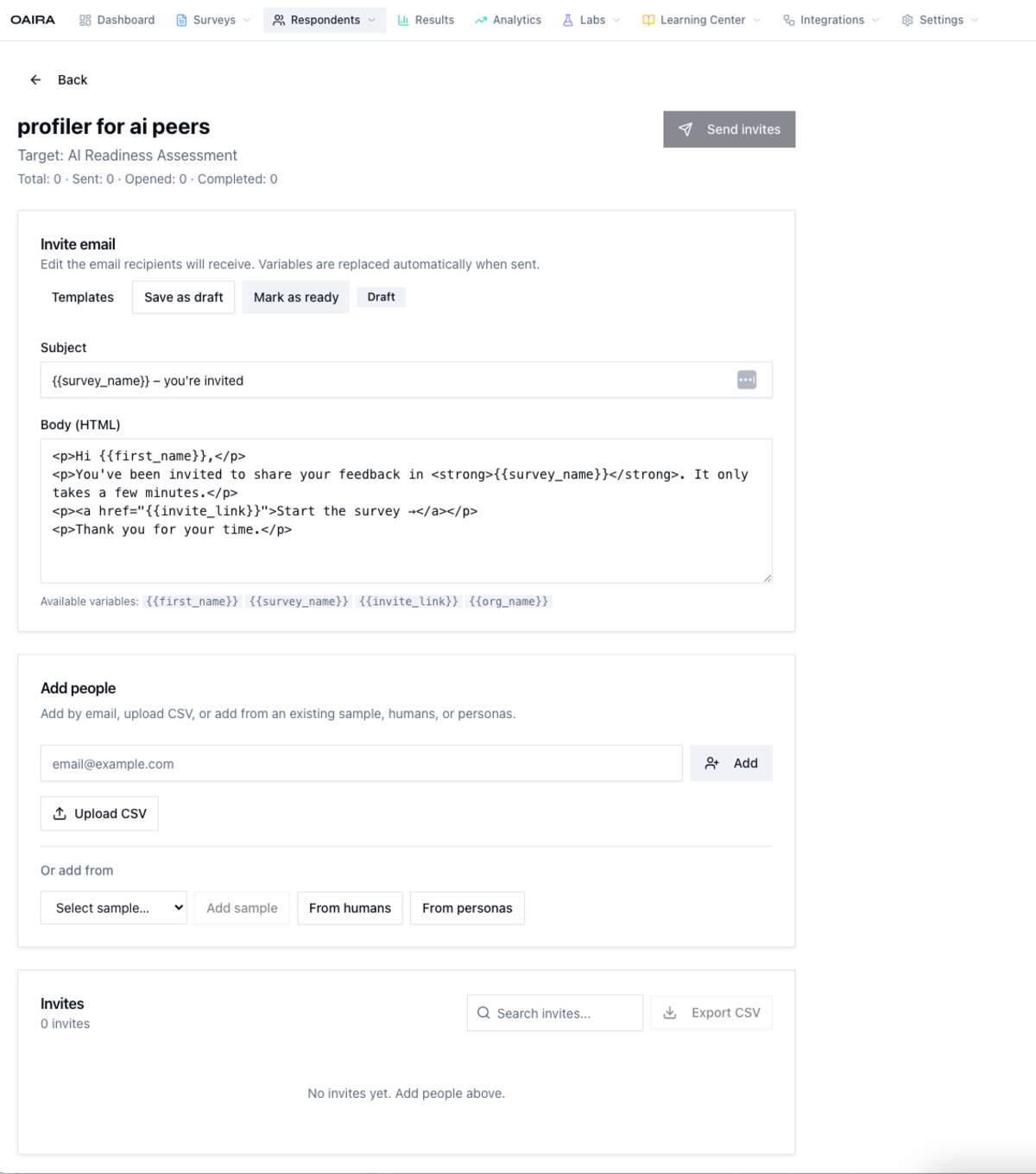
The Respondent Pool Interface
When you set up a respondent pool in OAIRA, you have four ways to add people:
- Email — Add individual respondents by email address. The platform handles invitation, tracking, and reminders.
- CSV upload — Bulk-add from a contact list. Merge field variables (
{{first_name}},{{survey_name}},{{invite_link}}) are replaced automatically at send time. - From existing samples — Draw from previously defined research samples stored in the platform.
- From humans / From personas — The distinctive OAIRA capability. Add real registered users or AI-simulated personas from your persona library.
The invite email is fully configurable: subject line, body HTML, merge fields. You can save templates, mark invites as ready, and track sent/opened/completed status for each respondent in the pool.
What Personas Are
OAIRA personas are not generic synthetic users. They're rich, multi-dimensional profiles generated by AI from a research-specific description — demographics, psychographics, behavioral patterns, domain expertise, and response tendencies.
A persona for an AI readiness assessment might be a mid-level operations manager at a healthcare organization, technically cautious, positive on ROI arguments, skeptical of vendor claims, with a specific relationship to data governance concerns.
When that persona responds to a survey, OAIRA's Simulation Persona agent embodies the profile: it answers questions the way that person would answer them, with appropriate domain knowledge, consistent with their psychographic tendencies, and with realistic variation.
This is not the same as random synthetic data. It's structured inference about how a specific kind of person responds to specific research questions.
Why Mix Human and Synthetic?
The case for blended research isn't that synthetic respondents are as good as real ones. It's that they serve different purposes, and combining them unlocks capabilities neither provides alone.
Pre-field validation. Run the study through synthetic personas before deploying to real respondents. Identify questions that produce unexpected distributions, branching paths that are never triggered, or response patterns that suggest design problems. Fix the instrument before it reaches humans.
Augmentation. A real respondent pool of 40 with a synthetic augmentation of 200 gives you statistical power for subgroup analysis that 40 responses alone cannot support — while preserving the authenticity of real human data at the core.
Hard-to-reach segments. Some respondent populations are expensive or slow to recruit. A synthetic representation of that segment, built from validated persona profiles, can inform research design and hypothesis development while real recruitment proceeds.
Counterfactual analysis. Ask "what would our results look like with a different audience mix?" by running the same instrument through a synthetic version of that audience. The human data anchors you; the synthetic variation explores the space around it.
The Data Integration
The crucial design decision in OAIRA's blended approach: human and synthetic responses live in the same data model.
Survey results aren't segregated into "real" and "synthetic" databases. They're tagged with the respondent type, but they're analyzed through the same interface, with the same methodology-specific analysis, against the same question schema.
This means you can:
- Filter to human-only responses for final reporting
- Compare human vs. synthetic response distributions to evaluate simulation accuracy
- Run analysis on the full blended dataset where appropriate
- Track which findings replicate across both respondent types and which don't
The blend is not a workaround. It's a methodology.
The Research Design Implication
The moment your platform distinguishes between "from humans" and "from personas" as peer options in the same interface, your model of what research respondents are has changed.
In the traditional model, a respondent is a person who fills out your form. In the OAIRA model, a respondent is any entity that produces structured responses to research instruments — and that category includes AI-simulated personas calibrated to specific real-world profiles.
This isn't a statement about replacing human research. It's a statement about expanding the research design space. The tools available to researchers in 2026 are fundamentally different from the tools available in 2016, and the methodologies that use those tools well are only beginning to be worked out.
OAIRA is a place to work them out.
OAIRA is an AI-powered market research platform. Respondent pools support human respondents, synthetic personas, and blended studies across all research methodologies.